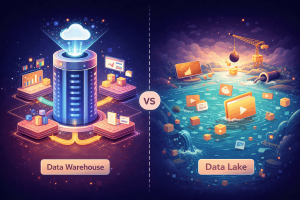
Data Warehouse
A database optimized for analytical queries, where data is structured and validated before storage.

A storage system for raw data in any format, where structure is applied at query time, not at ingestion.

A data lake is a storage system that accepts data in any format — structured tables, JSON logs, images, PDFs, raw sensor readings — and stores it exactly as it arrived. Unlike a data warehouse that validates and structures data before storing it, a data lake stores first and asks questions later.
This approach exists because not every piece of data has an obvious use at the time it is generated. Server logs, user behavior streams, IoT sensor readings — these might become valuable months or years later when a data scientist discovers a pattern. A data lake preserves that raw material, ensuring nothing is lost or pre-filtered before you know what questions to ask.
When data enters a data lake, nothing validates it. Nothing transforms it. The raw bytes are stored exactly as they arrived. Structure is applied later, only when you query. Let us trace what this means in practice.
Data arrives from multiple sources:
JSON logs from web server    → Stored as-is (raw JSON files)
CSV exports from vendor      → Stored as-is (raw CSV files)
Images from security cameras → Stored as-is (raw image files)
PDFs from contracts          → Stored as-is (raw PDF files)
API responses from partners  → Stored as-is (raw JSON/XML)
No schema required. No type checking. No validation. The data lake does not care what format the data is in — it just stores the bytes. This is fundamentally different from a data warehouse, where data must pass through ETL validation before it can enter.
At query time, the engine figures out structure on the fly:
Query engine reads raw files
  → Parses structure on the fly
  → Handles missing fields gracefully
  → Infers data types from content
  → Returns whatever it can extract

Example: "SELECT user_id, action FROM web_logs WHERE date = '2024-01-15'"
  → Engine opens JSON files for that date
  → Parses each JSON object
  → Extracts user_id and action fields
→ Skips records where fields are missingA data lake stores first, asks questions later. Structure is not enforced at write time — it is applied at read time. This is called schema-on-read. The cost of this flexibility is slower queries, because the engine must figure out the data structure every time you ask a question.
Data lakes apply structure when reading, not when writing. Let us trace what this means compared to a warehouse:
Schema-on-Write (Data Warehouse):
  Raw data → Validate → Transform → Store structured data
  Slow to write, fast to read

Schema-on-Read (Data Lake):
  Raw data → Store immediately → Apply structure at query time
  Fast to write, slower to read
This means queries are slower because the engine figures out structure on every read. But storage is fast and flexible — you never reject data, and you never need to know in advance what questions you will ask. The data is there, waiting for whatever question someone comes up with later.
| Aspect | Data Warehouse | Data Lake |
|---|---|---|
| Schema | Schema-on-Write (validate first) | Schema-on-Read (validate at query time) |
| Storage speed | Slower (validation and transformation required) | Fast (dump raw data immediately) |
| Query speed | Fast (data is pre-structured) | Slower (structure applied at read time) |
| Data quality | Enforced at entry — bad data rejected | Applied at query — bad data stored alongside good |
| Flexibility | Low (rigid schema, changes require migration) | High (any format, any structure) |
| Cost | Higher (optimized storage, compute for ETL) | Lower (bulk storage, minimal compute on write) |
| Best for | Known, recurring questions | Unknown, exploratory questions |
Many organizations use both: raw data lands in the data lake for safekeeping, then curated and validated subsets flow into the data warehouse for daily business reporting. This way, analysts get fast queries on clean data, and data scientists get access to the full raw dataset for exploration.
A data lake without governance becomes a data swamp — a massive collection of files that nobody can find, understand, or trust. This happens when teams dump data without documentation, naming conventions, or access controls.
Data Swamp:
  /data/export_2023_final_v2_FIXED.csv     ← What is this?
  /data/john_backup_temp.json              ← Who is John? Why temp?
  /data/old/new/data.parquet               ← Old or new?

Data Lake (governed):
  /raw/crm/customers/2024/01/15/full.json  ← Source, date, type clear
  /raw/web/events/2024/01/15/hourly/       ← Partitioned, discoverable
  /curated/sales/monthly_summary.parquet   ← Cleaned, documented
The difference is organization: clear naming conventions, consistent folder structures, metadata catalogs, and access controls. A data lake is not a dumping ground. It is a strategic asset that requires governance to remain useful.
Use a data lake when:
A data lake is not a dumping ground. It is a strategic asset that preserves optionality — the ability to ask questions you have not thought of yet. But without governance, it becomes a swamp.
Think of a data lake like a well-labeled storage unit. You can put anything in — boxes, furniture, equipment, documents. Finding something specific takes more time than a filing cabinet because you have to look through containers. But you never have to decide upfront where things go, you never have to throw anything away because it does not fit a category, and you always have the original item in its original condition when you need it later.
The key word is “well-labeled.” An unlabeled storage unit where boxes are stacked randomly is a nightmare. A storage unit where every box has a date, a source, and a content description is a valuable archive. The same is true for data lakes.
Flexibility and preservation in exchange for query complexity. You can store anything without planning, but finding and understanding that data requires more effort at query time. Governance is not optional — it is what separates a data lake from a data swamp.