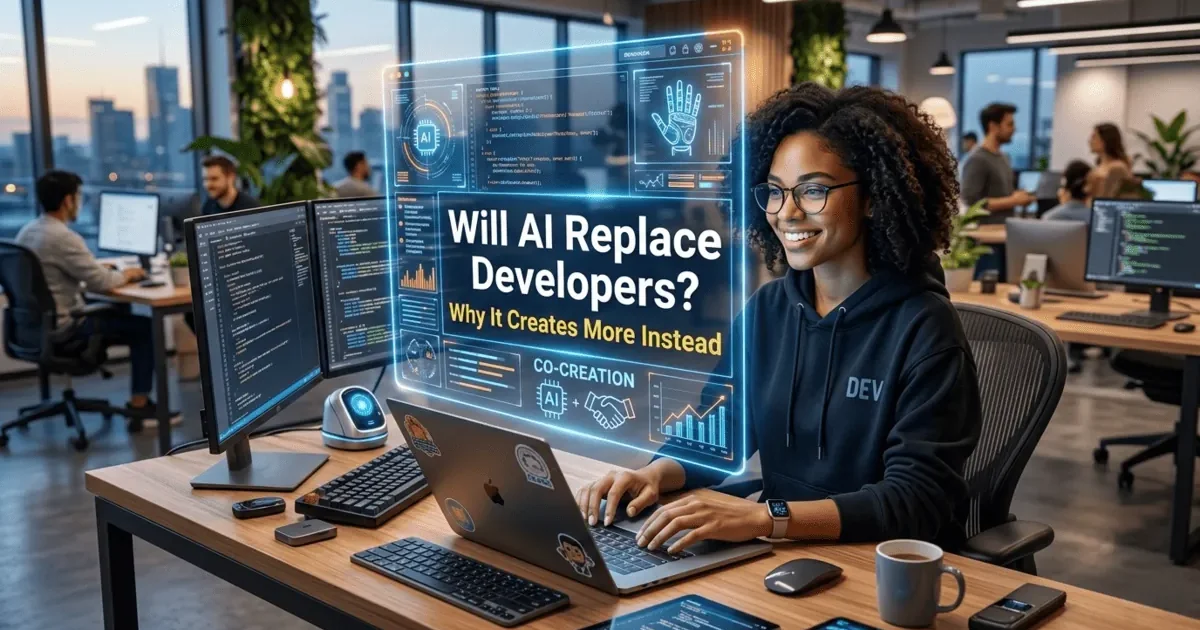
- Will AI Replace Developers? The Short Answer
- The Demand Explosion: Why More Software Gets Built
- When Non-Developers Hit the Wall
- New Roles AI Is Creating
- What AI Actually Replaces vs What It Creates
- The Jevons Paradox of Software Development
- The Skills That Matter More Now
- Anti-Patterns: Wrong Assumptions About AI and Jobs
- Key Takeaways
Will AI replace developers? The counter-intuitive answer is that AI is creating more developer jobs, not fewer. This seems to contradict the headlines. If AI can write code, why would you need humans? The answer lies in a pattern that has repeated throughout the history of technology: when a tool makes something cheaper and faster, demand for that thing explodes — and the explosion creates more total work, not less.
I have been asked some version of “will AI replace developers” by engineers, managers, and students regularly over the past two years. After watching how AI tools are actually changing software development from the inside — using them daily for over three years — my answer has become clearer and more confident: AI will not replace developers. It will replace certain development tasks while creating entirely new categories of work that did not exist before.
Will AI Replace Developers? The Short Answer
No. But AI will change what developers do. The distinction matters enormously for anyone planning their career or their team’s future.
Here is the clearest way I can put it: AI replaces coding tasks, not engineering roles. Writing boilerplate code, implementing standard patterns, translating between languages, generating documentation — these tasks are being automated. But the role of a software engineer was never just about these tasks. It was about understanding problems, designing solutions, making trade-offs, and ensuring systems work reliably in production. Those responsibilities are not being automated. They are becoming more important.
Think of what happened when calculators replaced manual arithmetic. Accountants did not disappear. The demand for financial analysis increased because calculations became instant. The job evolved from “person who can do math” to “person who can interpret numbers and make decisions.” The question “will AI replace developers” has the same answer that “will calculators replace accountants” had decades ago.
The Demand Explosion: Why More Software Gets Built
The most important factor in understanding whether AI will replace developers is the relationship between cost and demand. When the cost of producing something drops dramatically, demand does not stay constant — it increases, often by more than the cost decrease. This economic reality is the strongest argument against the “AI replace developers” narrative — efficiency does not eliminate demand, it multiplies it.
Right now, software development is expensive. Building a custom internal tool might cost a company $50,000 to $200,000. At that price point, most companies can only afford to build their most critical tools. Hundreds of useful applications never get built because the cost is too high relative to the benefit.
AI tools are reducing the cost of building software by 3 to 5 times for well-scoped projects. What happens when software development costs drop by 60 to 80 percent? Companies start building things they never would have built before:
- Internal dashboards that were “nice to have” become “let us just build it”
- Automation workflows that were too expensive to justify suddenly make sense
- Prototypes that would have taken months can be tested in weeks
- Custom integrations between systems replace manual data entry
- Niche tools for specific teams that never had engineering priority
| Before AI Tools | After AI Tools |
|---|---|
| 10 developers, 1 project at a time | 10 developers, 3 to 5 projects in parallel |
| Only high-priority tools get built | Medium and low-priority tools also get built |
| Prototypes take months | Prototypes take days to weeks |
| Custom integrations are expensive | Custom integrations are affordable |
| Non-engineering teams wait in queue | Non-engineering teams get tools faster |
| Total software projects per year: 5 to 10 | Total software projects per year: 20 to 50 |
Each of these projects still needs someone to define requirements, design the architecture, review the output, handle edge cases, ensure security, and maintain the system. AI generates the code faster, but it does not eliminate the engineering work around the code. And because there are now 3 to 5 times more projects, the total engineering work may actually increase. This demand explosion is why the “AI replace developers” prediction misses the bigger picture entirely.
When Non-Developers Hit the Wall
One of the most interesting dynamics in the “will AI replace developers” debate is what happens when non-developers start building software with AI tools. This is already happening at scale, and the results are instructive.
Tools like Cursor, Replit, and ChatGPT allow product managers, designers, and business analysts to generate working applications. A product manager can describe a feature, and the AI generates a functional prototype. This feels like the end of professional software development. But then the prototype hits reality:
Day 1: Product manager uses AI to build internal tool
       → Works great for 5 users in the demo
       Result: "We do not need developers for this!"

Week 2: Tool gets 50 users
       → Database queries start slowing down
       → No indexing, no query optimization
       Result: "Can someone from engineering look at this?"

Month 1: Tool has 200 users
       → Authentication bypass found
       → Data inconsistency issues appear
       → No error logging, no monitoring
       Result: "We need a developer to fix this"

Month 2: Developer inherits the codebase
       → AI-generated code with no architecture
       → Multiple conflicting patterns
       → No tests, no documentation of decisions
       Result: Developer spends more time rewriting than building from scratch

Lesson: AI tools lower the barrier to create software.
        They do not lower the barrier to create reliable software.
        The gap between "works in demo" and "works in production"
        still requires engineering expertise.
This pattern does not mean non-developers should not use AI tools. It means that AI tools expand who can create prototypes and simple tools, while increasing demand for engineers who can make those tools production-ready. Non-developer creation feeds into developer refinement. It is additive, not replacive. So when people use non-developer coding as evidence that AI replace developers fears are justified, they are missing the second half of the story.
I have seen this happen in real organizations. A business team builds an AI-generated tool. It works. It gets adopted. It becomes critical. And then it needs an engineer to make it reliable, secure, and scalable. The AI tool created the demand for engineering — it did not eliminate it.
New Roles AI Is Creating
Rather than asking “will AI replace developers,” a more useful question is “what new roles is AI creating?” Because the answer is: quite a few.
| New Role | What They Do | Why It Exists |
|---|---|---|
| AI Code Auditor | Reviews AI-generated code for security, performance, and architectural issues | AI generates code nobody reviewed — someone needs to audit it |
| AI System Architect | Designs systems that combine AI components with traditional engineering | AI-native applications need architects who understand both worlds |
| Context Engineer | Builds and maintains the context systems that make AI tools effective | AI quality depends on context — someone needs to engineer that context |
| AI Orchestration Engineer | Builds workflows that coordinate multiple AI agents | Complex tasks require multiple AI models working together |
| AI Quality Engineer | Tests and validates AI-generated outputs at scale | Traditional QA does not cover AI-specific failure modes |
| Prompt Workflow Designer | Creates reusable prompt templates and AI workflows for teams | Effective AI usage requires systematic prompt design |
None of these roles existed three years ago. All of them are emerging because AI tools create new categories of work. The AI Code Auditor role, in particular, is growing rapidly — because every team using AI tools is generating code that needs human review, and not every developer has the experience to review effectively.
As we discussed in Why AI Needs Better Memory, context engineering alone is becoming a discipline. The quality of AI output depends directly on the quality of context provided, and building effective context systems requires engineering skills that go beyond traditional software development.
What AI Actually Replaces vs What It Creates
To answer “will AI replace developers” precisely, we need to separate the tasks that are being automated from the tasks that are being amplified or created.
| Category | Being Replaced | Being Amplified | Being Created |
|---|---|---|---|
| Coding | Boilerplate, CRUD, repetitive patterns | Complex implementation with AI assistance | AI-specific code patterns, prompt workflows |
| Testing | Basic unit test writing | Test strategy, edge case identification | AI output validation, hallucination detection |
| Documentation | API docs, inline comments | Architecture decision records | AI context documentation, prompt libraries |
| Debugging | Simple syntax and logic errors | Complex system debugging with AI help | AI-generated code auditing, architectural review |
| Architecture | Nothing significant | Design exploration, pattern evaluation | AI-native system design, agent orchestration |
| Operations | Simple monitoring alert responses | Incident analysis, capacity planning | AI system monitoring, model performance ops |
The pattern is clear: low-judgment, repetitive tasks are being replaced. High-judgment, context-dependent tasks are being amplified. And entirely new categories of work are being created. The net effect is a shift in what developers do, not a reduction in how many developers are needed. Anyone who believes AI replace developers claims is looking at only one column of this table and ignoring the other two.
The Jevons Paradox of Software Development
There is an economic concept that perfectly explains why AI will not replace developers. It is called the Jevons paradox, named after the economist William Stanley Jevons who observed in 1865 that making coal engines more efficient did not reduce coal consumption — it increased it. More efficient engines made coal-powered machines cheaper to operate, which led to more machines being built, which consumed more total coal than before.
The same principle applies to software development and explains precisely why the “AI replace developers” theory falls apart. AI makes software cheaper to produce. Cheaper production leads to more software being built. More software requires more engineering oversight, maintenance, security review, and system design. The total amount of engineering work increases even though each individual task takes less time.
We are already seeing this. Companies that adopted AI coding tools are not laying off developers — they are building more software with the same teams and hiring more developers to manage the expanding portfolio. The efficiency gain gets absorbed by increased demand, not by headcount reduction.
This does not mean every developer’s job is safe. Developers whose only skill is writing standard code in a single language will find that skill less valuable. But developers who can design systems, evaluate trade-offs, ensure security, and manage complexity will find their skills more demanded than ever.
The Skills That Matter More Now
If the question is not “will AI replace developers” but “what skills should developers invest in,” here are the ones that become more valuable as AI takes over code generation:
System design and architecture. The ability to decompose a complex problem into components, define interfaces, choose patterns, and make trade-offs. AI cannot do this for your specific context. This skill becomes the primary differentiator.
Code evaluation and review. Reading code critically — not just for correctness but for security, performance, maintainability, and architectural fit. As AI generates more code, the ability to evaluate that code becomes a bottleneck skill.
Domain knowledge. Understanding the business context your software serves. Why does this calculation work this way? What regulatory requirements apply? What happens to the user if this fails? Domain knowledge shapes every technical decision and AI does not possess it.
Debugging complex systems. When a distributed system fails in production, understanding how to trace the failure across services, databases, queues, and networks. AI can help with individual debug steps but cannot navigate the investigation. As we explored in The Reality of AI in Production, production debugging requires experience that only comes from surviving incidents.
Communication and collaboration. Translating between business requirements and technical implementations. Explaining trade-offs to non-technical stakeholders. Coordinating across teams. These human skills become more valuable when technical implementation is automated because the coordination around implementation becomes the bottleneck.
Anti-Patterns: Wrong Assumptions About AI and Developer Jobs
| Wrong Assumption | Why People Believe It | What Actually Happens |
|---|---|---|
| “AI will replace all developers by 2030” | Impressive demos show AI building apps from prompts | Demos are not production. Maintenance, security, scaling, and debugging still need humans. |
| “Junior developers will be eliminated first” | AI handles simple tasks that juniors do | Junior roles evolve — they become AI-assisted, not eliminated. Companies still need people learning the craft. |
| “Only 10% of developers will be needed” | 1 developer + AI = 10 old developers | Jevons paradox: efficiency gains create more demand, not less. More software gets built. |
| “Non-developers will replace developers” | AI tools let anyone build software | Non-developers create prototypes that need engineering to become production systems. |
| “Coding skills are worthless now” | AI writes code faster than humans | Understanding code is essential for reviewing AI output. You cannot evaluate what you do not understand. |
Key Takeaways
- AI will not replace developers — it replaces coding tasks: The engineering role is broader than writing code. Design, architecture, security, evaluation, and maintenance are not being automated.
- The Jevons paradox applies to software: Cheaper software production leads to more software being built, which increases total engineering demand even as individual tasks become faster.
- Non-developer creation feeds into developer refinement: When non-engineers build AI-generated tools, those tools eventually need real engineering to become reliable. This creates demand, not competition.
- New roles are emerging that did not exist three years ago: AI Code Auditor, Context Engineer, AI Orchestration Engineer — the AI era is creating jobs, not just changing existing ones.
- Low-judgment tasks are replaced, high-judgment tasks are amplified: Boilerplate and repetitive coding are automated. System design, security thinking, and trade-off analysis become more important.
- Invest in evaluation skills, not just creation skills: The ability to critically review code, assess architecture, and identify risks becomes the bottleneck skill when code generation is automated.
- Experience compounds and becomes more valuable: Every system you have built, every failure you have debugged, every architectural decision you have lived with builds judgment that AI does not possess.
Further Reading
- The Future of Software Development
- Vibe Coding: Why AI-First Development Without Discipline Fails
- AI Technical Debt: The Hidden Cost of AI Coding Tools
- The AI Software Architect: The Essential Role for the Next Decade
- The AI-Native Software Stack: How Architecture Is Evolving
- The Reality of AI in Production