
- What Is Actually Changing in Software Development
- The Three Eras of Software Development
- What AI Handles Well Right Now
- What AI Cannot Do (And Probably Will Not Soon)
- The New Development Workflow
- How Developer Roles Are Evolving
- Why Coding Is Becoming the Smallest Part
- What Stays the Same No Matter What
- Anti-Patterns: Wrong Responses to the AI Shift
- Key Takeaways
The future of software development is not about AI replacing developers — it is about the role of the developer changing fundamentally. The shift that is happening right now, in 2026, is one of the biggest transitions the industry has seen since the move from assembly language to high-level programming. And like that earlier transition, the developers who survive are not the ones who resist the change — they are the ones who understand what is actually changing and what is not.
I have been building software for over 20 years and using AI tools daily for the past three. What I see is not the apocalyptic “AI replaces all programmers” narrative, and it is not the dismissive “AI is just autocomplete” narrative either. The reality is more nuanced, more interesting, and honestly more exciting than either extreme. The future of software development is a shift from writing code to directing systems — and that shift rewards experience, not just typing speed.
What Is Actually Changing in the Future of Software Development
To understand the future of software development, you need to separate what is genuinely new from what is marketing hype. Here is what is actually different:
Code generation is being commoditized. Writing code — the act of translating a design into syntax — is becoming cheap and fast. AI tools like Claude, GitHub Copilot, and Cursor can generate functional code from descriptions. This is real. It is not perfect, but it is good enough that the bottleneck in software development is shifting away from typing code.
The bottleneck is moving upstream. When code generation is fast, the limiting factor becomes everything that happens before and after the code is written: understanding the problem, designing the solution, reviewing the implementation, testing the edge cases, and maintaining the system over time. These are the activities that define the future of software development.
Software volume is exploding. Because code is cheaper to produce, more software is being built. More internal tools. More automations. More prototypes. More experimental features. This creates more engineering work, not less — but the nature of that work is changing.
The Three Eras of Software Development
Looking at the history of our industry, we are entering a third distinct era. Each era changed what developers spend most of their time doing.
| Era | Period | Developer’s Primary Activity | Bottleneck |
|---|---|---|---|
| Era 1: Manual Coding | 1960s–2020s | Writing code line by line | Typing speed, syntax knowledge, language expertise |
| Era 2: AI-Assisted | 2023–present | Reviewing and guiding AI-generated code | Review capacity, architectural judgment, context quality |
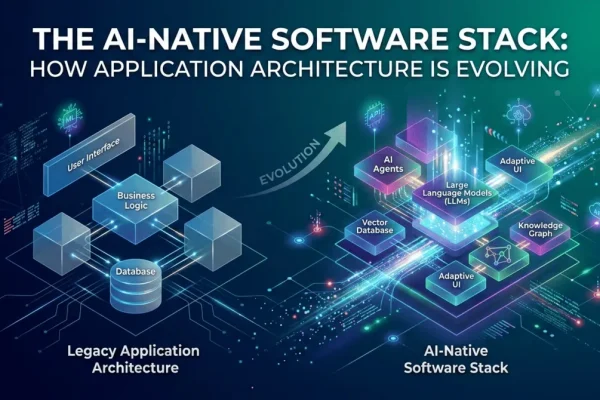
| Era 3: AI-Native | Emerging | Designing systems, orchestrating AI agents | System thinking, domain understanding, judgment |
We are currently in the transition between Era 2 and Era 3. Most developers are in Era 2 — they use AI tools to help write code but still think of themselves as coders. The future of software development belongs to Era 3 developers who think of themselves as system designers who happen to use AI for implementation.
This transition is not hypothetical. I see it in my own work. Three years ago, I spent most of my day writing code. Today, I spend most of my day designing systems, reviewing AI output, and making architectural decisions. The code gets written faster than ever, but my value has shifted from the code itself to the decisions around the code.
What AI Handles Well Right Now
Being honest about what AI does well is important for understanding the future of software development. AI is not equally good at everything. Here is what it genuinely excels at today:
Boilerplate and CRUD operations. Creating standard API endpoints, database models, form validation, and repetitive patterns. AI eliminates the tedious parts of development with high accuracy.
Code translation and migration. Converting code between languages, frameworks, or versions. AI handles syntax translation well because it is pattern matching at scale.
Documentation and comments. Generating inline documentation, README files, and API documentation from existing code. AI is thorough and consistent at this.
Test implementation. Given specific test cases, AI can write the test code efficiently. It struggles with deciding what to test but excels at writing the implementation once you define the scenarios.
Pattern application. Implementing well-known design patterns, following established conventions, and applying standard solutions to standard problems. If the problem has been solved before, AI can apply the solution.
Debugging assistance. Identifying syntax errors, suggesting fixes for common bugs, and explaining error messages. AI is a powerful debugging companion when you understand the system and just need help with specific issues.
What AI Cannot Do (And Probably Will Not Soon)
Understanding AI’s limitations is more important for the future of software development than understanding its capabilities. The limitations define where human engineers remain essential.
System design under constraints. Real engineering is about trade-offs. Do you optimize for speed or memory? Do you use a microservice or keep it monolithic? Do you build for scale now or when you need it? These decisions depend on context that AI does not have — your team size, your budget, your deployment environment, your growth projections, your operational capacity. AI can suggest architectures but cannot make informed architectural decisions for your specific situation.
Domain understanding. Software exists to solve business problems. Understanding why a tax calculation must use banker’s rounding, why a healthcare system needs audit trails with specific retention policies, or why a trading system must handle partial fills — this domain knowledge shapes every technical decision. AI can implement rules you specify but cannot determine what rules your domain requires.
Long-term architectural coherence. Every individual decision AI makes might be locally optimal. But maintaining a coherent architecture across a growing codebase requires understanding how today’s decision affects next month’s features. AI operates prompt by prompt. Architectural coherence requires a mental model of the entire system over time. This is why AI technical debt is becoming a real problem — AI produces locally correct, globally incoherent systems.
Security thinking. Real security is not about applying rules. It is about thinking adversarially — imagining how someone would exploit your system. AI can implement security patterns, but it does not think like an attacker. It does not consider that a timing difference in your login response might leak whether a username exists. It does not realize that your file upload handler could be exploited to overwrite system files. Security requires paranoia that AI does not possess.
Knowing when to say no. Sometimes the best engineering decision is to not build something. The feature is not worth the complexity. The integration will create more problems than it solves. The technical approach is wrong for the business stage. AI will always try to build what you ask for. Experienced engineers know when to push back on requirements, simplify scope, or propose alternative solutions. This judgment comes from experience with the consequences of over-engineering.
| Capability | AI Handles Well | Humans Still Essential |
|---|---|---|
| Code generation | Boilerplate, CRUD, patterns | Novel algorithms, creative solutions |
| Architecture | Suggesting standard patterns | Choosing patterns for specific constraints |
| Testing | Implementing defined test cases | Deciding what to test and why |
| Debugging | Finding syntax errors, common bugs | Root cause analysis in complex systems |
| Security | Applying known security patterns | Adversarial thinking, threat modeling |
| Documentation | Describing what code does | Explaining why decisions were made |
| Design | Following established conventions | Making trade-offs under constraints |
The New Development Workflow
The future of software development is not just about using AI tools — it is about restructuring the development workflow around AI’s strengths while compensating for its weaknesses.
OLD WORKFLOW (Era 1: Manual Coding)
───────────────────────────────────
Requirements → Design → Write Code → Test → Debug → Deploy
                        ▲
                        │
                 Most time spent here

NEW WORKFLOW (Era 2-3: AI-Native Development)
─────────────────────────────────────────────
Requirements → Design → Prompt AI → Review Output → Refine → Test → Deploy
               ▲                     ▲                        ▲
               │                     │                        │
        Most time here       Critical checkpoint       Define scenarios yourself
Notice where the time shifts. In the old workflow, writing code was the longest phase. In the new workflow, design and review consume the most time. The code generation itself is fast — minutes instead of hours. But the design that precedes it and the review that follows it become more important, not less.
This is why the future of software development favors experienced engineers. Design skill comes from building systems that failed. Review skill comes from debugging systems that broke. These are not skills you can shortcut with AI — they are the product of years of experience with consequences.
How Developer Roles Are Evolving
The future of software development is reshaping every level of the engineering career ladder. Here is what each role is becoming:
| Level | Traditional Role | Evolving Role | Key New Skill |
|---|---|---|---|
| Junior | Write code, fix bugs, learn patterns | Prompt engineer, review AI output, learn systems | Knowing what to ask AI and when to question the answer |
| Mid-level | Own features, write tests, improve code quality | AI code auditor, integration reviewer, pattern enforcer | Evaluating AI output against architectural standards |
| Senior | Design systems, mentor team, make technical decisions | System architect, AI workflow designer, quality guardian | Defining constraints that make AI output consistently good |
| Staff/Principal | Technical strategy, cross-team architecture | AI orchestration architect, engineering culture lead | Building systems where AI and humans collaborate effectively |
The common thread across all levels is that evaluation and judgment become more important than implementation. Every level shifts from “doing the work” to “directing and validating the work.” This does not make the roles easier — it makes them require different skills. An AI software architect needs all the system design knowledge of a traditional architect plus the ability to effectively constrain and guide AI tools.
Why Coding Is Becoming the Smallest Part of Software Development
This might be the most important insight about the future of software development: coding was always the easiest part. We just did not realize it because it took the most time.
Think about what makes a software project succeed or fail. It is rarely the code itself. Projects fail because of:
- Wrong requirements — building the wrong thing
- Poor architecture — building the right thing the wrong way
- Missing edge cases — not thinking about what could go wrong
- Scalability surprises — not planning for growth
- Security breaches — not thinking adversarially
- Maintenance nightmares — not designing for change
None of these failures are about code quality at the line level. They are all about decisions made before or around the code. AI makes the code part faster but does not help with any of these failure modes. If anything, AI makes some of them worse by enabling teams to build more code before the fundamental problems become visible.
The future of software development is the future of engineering decisions, not code production. The developer who understands trade-offs, constraints, failure modes, and system behavior will be more valuable than ever. The developer whose only skill is writing code will find that skill increasingly commoditized.
What Stays the Same No Matter What
Amid all the change, some fundamentals of software engineering remain constant. These are the bedrock that the future of software development is built on:
Understanding the problem still matters most. No amount of AI coding speed helps if you are solving the wrong problem. Requirements analysis, user empathy, and domain understanding remain the foundation of useful software.
Trade-offs do not disappear. Every technical decision involves giving up something to get something else. Faster vs more memory. Simpler vs more flexible. Build now vs build later. AI does not resolve trade-offs — it just generates implementations faster. The decisions still need human judgment.
Systems still fail. Distributed systems have network partitions. Databases have deadlocks. APIs have rate limits. Users do unexpected things. No AI tool changes the fundamental complexity of running systems in production. Understanding failure modes remains an essential engineering skill.
Communication still determines project success. The best architecture, the cleanest code, the most sophisticated AI tooling — none of it matters if the team cannot communicate effectively about what they are building and why. As we discussed in The Reality of AI in Production, the human coordination challenges are often harder than the technical ones.
Experience compounds. Every production incident you have survived, every architectural decision you have lived with, every debugging session at 3 AM — these experiences build judgment that no AI model possesses. The future of software development does not devalue experience. It makes experience the primary differentiator between developers who can direct AI effectively and those who cannot.
Anti-Patterns: Wrong Responses to the AI Shift
| Anti-Pattern | The Mindset | Why It Fails | Better Response |
|---|---|---|---|
| The Denier | “AI is just hype, it will pass” | AI tools are measurably improving productivity — ignoring them is falling behind | Learn the tools, understand their limits, use them deliberately |
| The Surrenderer | “AI will replace me, why bother” | AI increases demand for engineering judgment — your skills matter more | Focus on the skills AI cannot replicate: design, evaluation, domain knowledge |
| The Vibe Coder | “AI writes the code, I just ship features” | Creates massive AI technical debt that eventually halts progress | Use AI for implementation, maintain your understanding of the system |
| The Purist | “Real engineers write their own code” | Refusing to use power tools does not make you a better carpenter | AI is a tool — use it for what it does well, maintain standards for what it does not |
| The Predictor | “In 2 years AI will do everything” | Predictions about AI timelines are consistently wrong — plan for what exists | Adapt to current capabilities, prepare for gradual evolution, do not bet on predictions |
The right response to the future of software development is neither panic nor complacency. It is deliberate adaptation. Learn the tools. Understand their limitations. Invest in the skills that AI makes more valuable, not less. And keep building — because the engineering experience you gain today is exactly what makes you effective in the AI era.
Key Takeaways
- The future of software development is a role shift, not a replacement: Developers are evolving from coders to system designers. Code generation is being commoditized, but system thinking, architecture, and judgment are becoming more valuable.
- We are in the transition between Era 2 and Era 3: Most developers use AI to help write code (Era 2). The future belongs to developers who design systems and orchestrate AI implementation (Era 3).
- AI excels at implementation, not decisions: Boilerplate, patterns, translation, and documentation are AI strengths. System design, security thinking, domain understanding, and trade-off analysis remain human responsibilities.
- The new workflow puts design and review at the center: Code generation is fast. Design before and review after are where the real work happens. Experienced engineers benefit most from this shift.
- Coding was always the easiest part of software development: Projects fail because of wrong requirements, poor architecture, and missed edge cases — not because of code syntax. AI makes code faster but does not solve these harder problems.
- Experience becomes the primary differentiator: Every production incident, every debugging session, every architectural decision you have lived through builds judgment that AI does not possess. This judgment is what separates effective AI-era developers from the rest.
- The right response is deliberate adaptation: Neither panic nor complacency. Learn the tools, understand their limits, invest in design and evaluation skills, and keep building real systems.