
Data Lake
A storage system for raw data in any format, where structure is applied at query…

A side-by-side comparison of data warehouses and data lakes, when to use each, and why modern systems use both together.
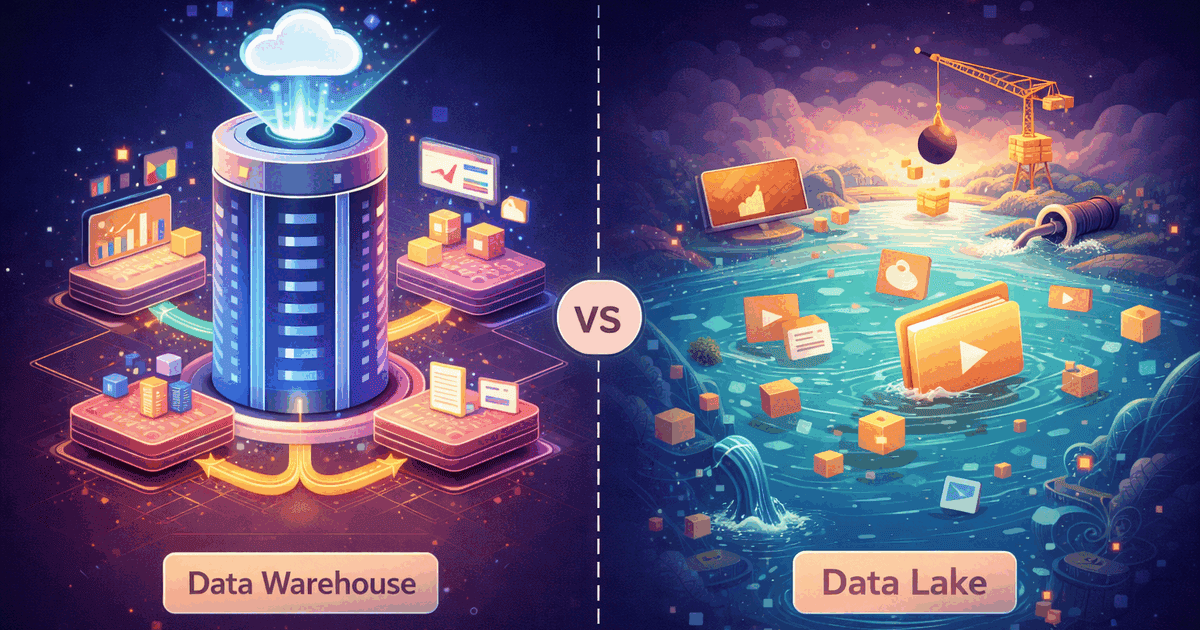
The easiest way to understand the difference between a data warehouse vs data lake is to think about it as order versus raw potential.
A data warehouse is like a structured library. Every book is categorized, indexed, and placed on a specific shelf. You go there when you have a specific question and need a precise, clean answer. It uses a schema-on-write approach — the data must be cleaned, validated, and formatted before it enters the warehouse. The upfront work is significant, but the payoff is fast, reliable queries.
A data lake, on the other hand, is like a massive body of water. It holds everything in its natural state — structured tables, images, PDFs, raw logs, JSON streams. It uses schema-on-read — you do not worry about the format until you are ready to dive in and analyze it. Storage is fast and flexible, but queries require more work because the engine must figure out the data structure at read time.
The difference is not just about storage — it is about when structure gets applied to your data.
Data Warehouse (Schema-on-Write):
  Raw data → ETL validates types, cleans values, enforces schema → Stored structured
  ↳ Bad data rejected at entry. Only clean data gets in.
  ↳ Queries are fast: the database knows the exact structure.

Data Lake (Schema-on-Read):
  Raw data → Stored immediately as-is → Structure applied when queried
  ↳ All data accepted. Nothing rejected.
  ↳ Queries are slower: the engine parses structure on every read.
This timing difference has real consequences. A data warehouse query for “total revenue by region” runs in seconds because every row is pre-structured with consistent types. The same query against a data lake takes longer because the engine must read raw files, infer types, handle inconsistencies, and skip malformed records.
| Feature | Data Warehouse | Data Lake |
|---|---|---|
| Data structure | Highly structured (tables, rows, defined types) | Raw, unstructured, or semi-structured (any format) |
| Schema approach | Schema-on-Write (cleaned before storage) | Schema-on-Read (stored raw, cleaned at query time) |
| Primary users | Business analysts and executives | Data scientists and engineers |
| Processing | ETL (Extract, Transform, Load — cleaned before storage) | ELT (Extract, Load, Transform — stored raw, cleaned later) |
| Query speed | Fast (pre-structured, indexed, optimized) | Slower (structure applied at read time) |
| Storage cost | Higher (optimized storage, compute for ETL) | Lower (bulk storage, minimal compute on write) |
| Flexibility | Low (rigid schema, changes require migration) | High (accept any format, evolve freely) |
| Best for | Predictable, recurring reports and dashboards | Deep discovery, machine learning, and exploration |
Most modern companies actually use both. The pattern looks like this:
Source Systems (CRM, ERP, logs, IoT)
       ↓
  Data Lake (store everything raw)
       ↓
  ETL pipelines select and clean the most important data
       ↓
  Data Warehouse (structured, fast, trusted)
       ↓
  Dashboards, reports, business intelligence

Meanwhile, data scientists query the lake directly
for exploration, machine learning, and discovery.
Raw data flows into the data lake for safekeeping. The most important and frequently queried subsets get cleaned and loaded into the data warehouse for daily analytical queries. This hybrid approach gives you the speed of a warehouse for known questions without losing the granular detail of the raw data for questions you have not thought of yet.
The data lake is the safety net — nothing is lost, nothing is pre-filtered. The data warehouse is the fast lane — pre-structured, optimized, and trusted. Together, they cover both the predictable reporting needs of today and the unknown analytical questions of tomorrow.
It is not warehouse OR lake — it is warehouse AND lake. The lake preserves everything in its raw form. The warehouse serves the structured, trusted data that drives daily decisions. Use the lake for exploration and the warehouse for execution.