The 80/20 Framework Architecture: Maximizing Reuse in ETL Systems
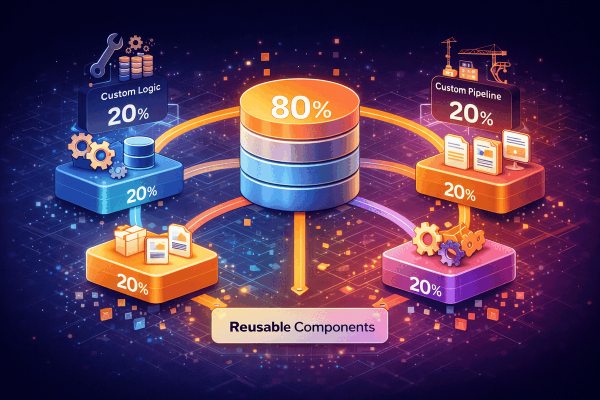
80 percent of ETL code is the same across every pipeline. The 80/20 framework captures that common infrastructure so you focus on what makes your pipeline unique.

 System Blueprints
 80 percent of ETL code is the same across every pipeline. The 80/20 framework captures that common infrastructure so you focus on what makes your pipeline unique.
 System Blueprints
 AI systems need data structured for embeddings and vector storage. Traditional ETL stops at the database. AI-ready ETL continues to the vector store.
 System Blueprints
 Hard-coded field mappings work until they do not. Configuration-driven ETL lets you change behavior without changing code.
 System Blueprints
 Foreign keys create dependencies. Order matters. Load tables wrong and every insert fails. Here is how to manage multi-table dependencies.
 System Blueprints
 When an ETL pipeline fails at 3 AM, you need to know exactly what happened. Event-driven observability gives you that story.
 System Blueprints
 Phone numbers arrive in 47 different formats. Dates come as strings or 0000-00-00. These production-tested cleaners handle edge cases that break naive implementations.
 System Blueprints
 With thousands of records, loading everything into an array crashes your server. Iterator patterns solve this by processing one record at a time, keeping memory constant.
 System Blueprints
 Your ETL pipeline fails when everything is tangled together. The 6-phase pattern separates responsibilities so failures become obvious and debugging becomes easy.